Saturday, March 11, 2017

Powered exoskeleton - An Iron Man on Every Corner

Powered exoskeletons are a wearable mobile machine that is powered by a system of electric motors, pneumatics, levers, hydraulics, or a combination of technologies that allow for limb movement with increased strength and endurance.

For a long time the concept of a true powered Exosuit was confined to the realm of science fiction but in 1960 one was finally created. Co-Developed by the US Armed Forces and General Electric, the Hardiman suit was an exoskeleton that allowed someone to lift a 250lb item like it was 10lbs. Run using hydraulics and electricity, the suit amplified the wearers strength by a factor of 25, meaning that lifting 25 kilograms (55lbs) in the suit was as easy as lifting 1 kilogram (2lbs) without. Here is a video of a US army prototype in action. https://www.youtube.com/watch?v=p2W23ysgWKI

Powered Exosuis have a variety of applications in an assortment of areas, from medical to military and even civilian. These suits could give people without the ability to walk increased independance, and help those working on rehabilitation. in the military sector Exo Suits will decrease the burden of gear a soldier must carry allowing them to do more for longer, but it can also allow them to weild heavier armerments. In the civilian life Firefighters and other rescue workers would be able to be safer and do more in dangerous environments and construction workers could use heavy power tools without the strain curently involved.

There are however limitations and other issues involved with the development and production of exo suits. Power supply is one issue being worked through, current non rechargeable batteries don't have a long enough life and rechargable batteries would require a charger to be brought along, not to mention the time factor of chrging. the skeleton and acuators must also be strong but light otherwise much of the exo suits power would be dedicated to just moving itself.

These problems are being worked on though and technology in these areas is improving seadilly with major breakthroughs every no and then. Lastly here are some pictures of exosuits, frirst you will see a real system then design concept and last a "currently" sci-fi suit concept, I say currently because the suit in the last image is based on a real suit. http://www.livescience.com/38779-elysium-exosuit-science-fiction.html


How Exoskeletons Will Work
Kevin Bonsor-Patrick J. Kiger - http://science.howstuffworks.com/exoskeleton.htm

DARPA Tests Battery-Powered Exoskeletons on Real Soldiers
Evan Ackerman Posted 22 Sep 2015 | 19:00 GMT - http://spectrum.ieee.org/video/robotics/military-robots/darpa-tests-batterypowered-exoskeletons-on-real-soldiers

Powered exoskeleton
https://en.wikipedia.org/wiki/Powered_exoskeleton

Wednesday, March 1, 2017

Graphene - A Super Material We Don't Quite Get Yet

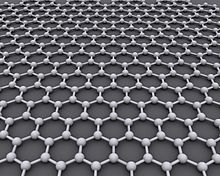
Graphene is an allotrope (meaning "other form") of carbon, where in it exists on an atomic scale as a two dimensional hexagonal lattice. The lattice is built using each atom as a vertex, here is an image showing how it would look on the atomic scale.
Graphene's composition allows for some startling features, three of them are:
  • It's the thinnest material known and presently believed to be the strongest.
  • It is a single layer of carbon atoms and is both flexible and transparent.
  • Graphene is astonishingly conductive for heat and electricity equally.


With features like this Graphene has garnered allot of attention which leads us to the main issue, production. Graphene is made by placing a sheet of copper foil in a furnace containing argon gas. You then place carbon atoms on the copper and cover them with a plastic coating and spun 3000 times a minute. The multi-layered sheet is later broken apart from a combination of chemicals, driving off the copper and most foreign material. The raw graphene is then loaded onto a silicon chip, before being subjected to a blast of gold pellets and plasma. If Graphene lives up to current theories, then it has the potential to be a scientific breakthrough in countless fields. In application Graphene bring us.

  • Ultra-fast uploads of terabits a second
  • Nearly instantaneous charging
  • Cleaning up the tainted water at fukushima
  • Improved tennis racquets
  • Unbreakable touch screens
  • A new generation of headphones
  • Graphene super capacitors would eliminate batteries

Graphene could even be used to make a water filter with holes small enough for water to pass through but not salt, even allowing bionic devices to connect directly to a patient’s neurons allowing them to relearn how to use their limbs. 

All of these things still only scratches the surface of what Graphene could potentially do, but there are still problems to overcome. Graphene is currently hard to produce on the scale that would be required to do the things listed above, but scientists are hard at work developing new ways to produce this super material. In 2015 a scientist developed a way to make better quality Graphene in much less time.


Citation
9 Incredible Uses for Graphene
Leslie Horn - http://gizmodo.com/5988977/9-incredible-uses-for-graphene

Graphene
https://en.wikipedia.org/wiki/Graphene

Graphene: Fast, Strong, Cheap, and Impossible to Use
John Colapinto - http://www.newyorker.com/magazine/2014/12/22/material-question

How Graphene Is Made And How It Was Discovered
Tech Times - http://www.techtimes.com/articles/166319/20160621/how-graphene-is-made-and-how-it-was-discovered.htm

There's a New Way to Build the Material of the Future
John Wenz - http://www.popularmechanics.com/science/a14651/this-scientist-invented-a-simply-way-to-mass-produce-graphene/

Sunday, February 19, 2017

Augmented Reality - The Crossroad of the Physical and Digital World


The definition of augmented reality (AR) is a technology that superimposes a computer-generated image on a user's view of the real world, thus providing a composite view.

Society is just starting to enter this arena now in the real world, but it has been a staple of science fiction for many years. As futuristic as augmented reality is, the earliest time the concept was mentioned is farther back then you might believe. In 1901 author L. Frank Baum, first references the notion of an electronic display/spectacles that overlays information onto real people, in this case it’s called a 'character marker'.

Over the next more than one hundred years society would grow and improve this concept with one of the most notable recent interpretations being Pokemon Go. At this point there are few people that don’t know at least a bit about what it is so I will keep the description brief. Pokemon Go is a location-based augmented reality game developed by the company Niantic in which players take on the role of pokemon trainers and travel around the real world while catching pokemon that exist superimposed onto a stylized map of their real world location.

In regards to hardware the foremost current example of AR would likely be Microsoft’s HoloLens. This is a visor that superimposes information on the user’s vision in a much more comprehensive way than considered by L. Frank Baum back in 1901. Here is a short video showing HoloLens in action. Even though this is a game there are so many other ways that AR can be used, and Microsoft is looking into all of them I’m sure. https://www.youtube.com/watch?v=29xnzxgCx6I
 
The effect that AR will have on the world is unknown but my belief is that most technology is neither good nor bad, and that it is up to us to find the right way to use it. I personally look forward to all of the amazing experiences that AR can bring society, however there will always be people that use this as an escape from the real world and that disconnect could be bad. Here’s an interesting video showing what the future “could” look like with mass adoption of AR. This however is only one possibility though. https://www.youtube.com/watch?v=YJg02ivYzSs

 Augmented reality. (2017, February 17). Retrieved February 19, 2017, from https://en.wikipedia.org/wiki/Augmented_reality#History

Winston, A. (2016, May 23). Keiichi Matsuda's Hyper-Reality film blurs real and virtual worlds. Retrieved February 19, 2017, from https://www.dezeen.com/2016/05/23/keiichi-matsuda-hyper-reality-film-dystopian-future-digital-interfaces-augmented-reality/

Wednesday, January 25, 2017

Vantablack - darker than dark


Vantablack is the name of a material comprised of carbon nano-tubes and is the blackest substance currently known.

The substance's design gives it the ability to absorb 99.965% of light. It is best described as a forest of vertical tubes of carbon and when light interacts with them instead of bouncing off, it becomes trapped in the forest of tubes and is eventually absorbed and converted into heat.

Vantablack was designed as a successor to the previous substance available at the time. The previous substance was developed by NASA and could only be grown 750 °C (1,380 °F) but Vantablack can be created at 400 °C (752 °F). this means that Vantablack can be grown on materials that cannot withstand higher temperatures.

The out gassing (release of a gas that was dissolved, trapped, frozen or absorbed) of Vantablack are low. This allows for the substance to be of actual commercial use, were in previous versions couldn't. It also has a greater resistance when dealing with mechanical vibration, and improved thermal stability.

Developed at the National Physical Laboratory in the UK, the term Vanta was not created until later.
The name means "Vertically Aligned NanoTube Arrays", and the substance is now being developed by Surrey NanoSystems in Newhaven England.

Here is a picture of Vantablack compared to dark black paint.
Image result for vantablack

Here is a video that shows Vantablack in action. https://www.youtube.com/watch?v=ObM7BTe_Jrw

(n.d.). Wikipedia, the free encyclopedia. Vantablack - Wikipedia. Retrieved January 25, 2017, from http://en.wikipedia.org/wiki/Vantablack

S. (n.d.). Youtube. Vantablack: The Darkest Material Ever Made - YouTube. Retrieved January 25, 2017, from http://www.youtube.com/watch?v=EP0rH8IR22c